Game Dev Articles
Sep 25, 2026 · 9 min read · DMG Forge
Unity Dev Tools Team Roles and Responsibilities: Define Ownership or Watch Friction Compound
Why Undefined Tool Ownership Tanks Your Build Pipeline Every Unity team hits the same wall: the build breaks, and four people open Slack at once, none of them sure whose job it is to fix it. That's not a tooling probl...
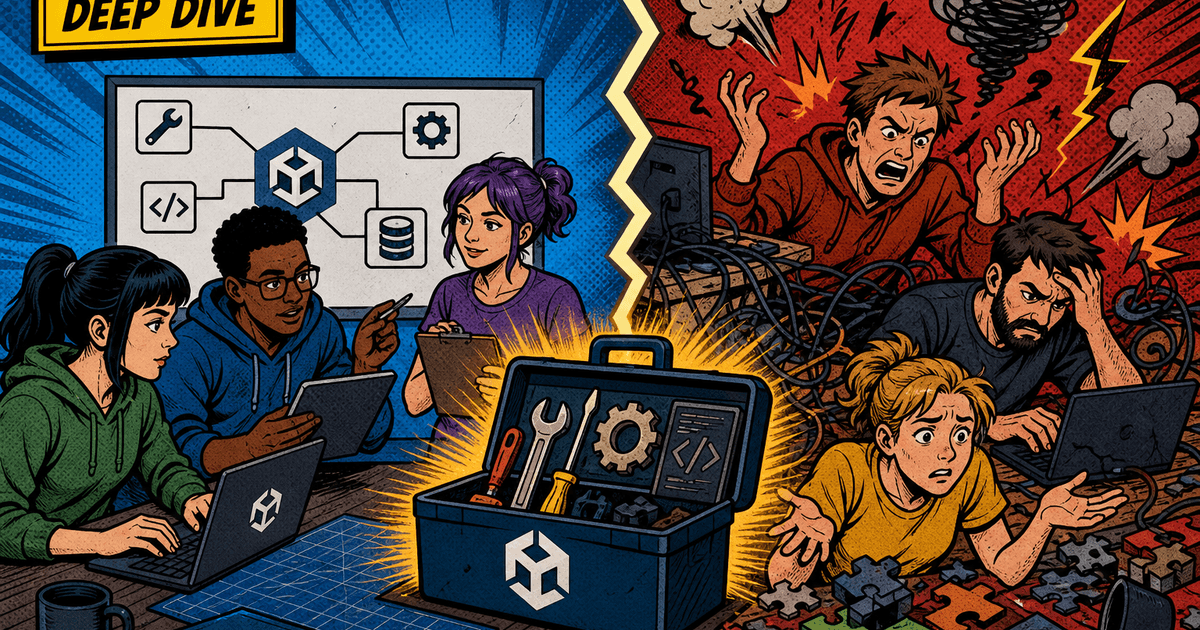
Why Undefined Tool Ownership Tanks Your Build Pipeline
Every Unity team hits the same wall: the build breaks, and four people open Slack at once, none of them sure whose job it is to fix it. That's not a tooling problem. That's a Unity dev tools team roles and responsibilities problem, and it's the single most common reason mid-size studios lose entire sprints to preventable fires.
When ownership is ambiguous, three things happen predictably:
- Duplicate work. Two engineers "fix" the same Addressables group conflict differently, and now you have two competing sources of truth.
- Silent regressions. Nobody owns shader variant counts, so they balloon for three months until a build fails on a platform nobody tested.
- Escalation paralysis. A crash report sits untriaged because it touches both build config and native plugin code, and both owners assume the other is handling it.
None of this is about hiring more people. It's about assigning explicit ownership to four functional roles that exist in every Unity pipeline whether you name them or not. Name them, and friction drops immediately.
The Build Architect: Owns Compilation, Addressables, and Platform Handoffs
The Build Architect is accountable for everything between "code compiles" and "build lands on a target device correctly." This role owns the Addressables content catalog, platform-specific Player Settings, and the scripting backend configuration (IL2CPP vs. Mono, Managed Stripping Level, Scripting Define Symbols).
Concretely, this person owns:
- Addressables group layout and remote catalog versioning. If content references break between builds, this is the person who explains why and fixes the labeling scheme.
- Platform handoff checklists. Switching from a Windows dev build to an iOS TestFlight build touches Player Settings, signing configs, and asset bundle variants. The Build Architect maintains the checklist so this isn't tribal knowledge.
- Scripting backend decisions. IL2CPP strips differently than Mono, and stripping level misconfigurations cause runtime exceptions that only show up on device. This role owns the stripping configuration and the linker XML overrides that keep required code from getting cut.
- Build time regression tracking. If your build time creeps from six minutes to twenty-two over a quarter, that's an ownership failure, not bad luck. The Build Architect tracks this metric and flags regressions before they compound.
If nobody holds this role explicitly, compilation issues get treated as "whoever's free" work, and platform handoffs turn into tribal knowledge that lives in one person's head - until that person is on vacation during a submission deadline.
The Performance Profiler: Owns Memory, Shader Compilation, and Runtime Metrics
This role is not "whoever notices the game feels slow." It's a defined owner of the Unity Profiler workflow, memory budgets, and shader variant management across target platforms.
Specific responsibilities:
- Memory budget enforcement. Using the Memory Profiler package, this person sets hard limits per platform (mobile vs. console vs. PC) and flags allocations that exceed them before they ship, not after a crash report comes in from the field.
- Shader variant stripping. Uncontrolled shader variants are one of the quietest sources of bloated build size and slow shader compilation on first run. The Performance Profiler owns the Shader Variant Collection setup and decides which keywords actually need to compile per platform.
- Frame time analysis. Using the CPU and GPU Usage Profiler modules, this person identifies whether a frame spike originates in script execution, rendering, or physics - and routes the fix to the right engineer instead of letting it bounce between teams.
- Runtime metric dashboards. If you're not capturing frame time, GC alloc per frame, and draw call counts in a persistent dashboard, you're relying on anecdotal "it feels fine" testing. This role sets that up and keeps it current.
The cost of skipping this role isn't abstract. A shader compilation stutter that ships because nobody owned variant stripping turns into a one-star review cycle that costs more engineering time to walk back than it would have taken to prevent.
The Integration Lead: Owns Version Control Strategy, CI/CD Configuration, and Dependency Management
Unity projects break in version control more often than almost any other engine, mostly because binary assets, scene files, and prefab serialization don't merge cleanly. The Integration Lead owns the branching strategy, merge conflict resolution process, and the CI/CD pipeline that turns commits into testable builds.
This role is accountable for:
- Version control configuration. Whether you're on Perforce or Git with LFS, this person owns the
.gitignorerules, Smart Merge settings for scenes and prefabs, and the lock policy for binary assets that can't merge. - CI/CD pipeline health. Unity Cloud Build, Jenkins, or a custom GitLab CI setup - whichever you use, someone has to own the build agent configuration, cache invalidation rules, and failure notification routing. If your CI pipeline fails silently and nobody's paged, that's not a tooling gap, that's an ownership gap.
- Package and dependency management. The Unity Package Manager manifest, third-party plugin versions, and native dependency conflicts all live here. This person tracks version pinning and vets upgrades before they hit main.
- Merge conflict escalation path. When two people edit the same scene and Smart Merge can't resolve it, there needs to be a defined resolution owner instead of a Slack thread that spirals for an hour.
Skipping this role means your CI pipeline degrades gradually. Caches go stale, build agents drift out of sync with local environments, and eventually nobody trusts the green checkmark anymore. A ten-minute cache clear today prevents a four-hour pipeline debugging session next sprint - but only if someone's actually watching for the warning signs.
The Debugging Specialist: Owns Debugging Tools, Log Aggregation, and Crash Analysis Workflows
This role owns the tooling that turns "the game crashed for one player in Ohio" into an actionable stack trace. Without a defined owner here, crash reports pile up unread, and the same bug class gets rediscovered by three different engineers over six months.
Core responsibilities:
- Log aggregation setup. Whether you're using Unity's built-in logging, a custom
ILogHandler, or a third-party service, this person owns the pipeline that gets device logs off end-user hardware and into a searchable system. - Crash analysis workflows. Native crashes (especially on IL2CPP builds) produce symbol-stripped stack traces that are useless without proper symbol upload. This role owns the symbol server configuration and the process for mapping crash addresses back to source.
- Debugging tool maintenance. Custom in-game debug consoles, remote inspector tools, and conditional compilation flags (
#if UNITY_EDITOR,#if DEVELOPMENT_BUILD) need active maintenance or they rot and stop reflecting current game state. - Bug triage routing. This person decides whether a reported issue is a build config problem, a performance regression, or an integration conflict, and routes it to the right owner from the roles above instead of letting it float.
The compounding cost here is subtle: every crash that goes untriaged for a week is a crash that's harder to reproduce a week later, because game state, save data, and build versions have all moved on.
Overlap Points That Create Friction: Define Boundaries Before They Burn Sprint Time
The four roles above aren't isolated - they intersect constantly, and the intersections are exactly where teams lose time arguing about whose problem something is. Define these boundaries explicitly:
- Build failures caused by shader errors. Is this the Build Architect's problem (compilation) or the Performance Profiler's (shader variants)? Rule: Build Architect owns the failure until it's isolated to a specific shader, then it's handed to the Performance Profiler.
- CI pipeline failures caused by dependency conflicts. Integration Lead owns the pipeline, but a broken package reference might be a Build Architect issue if it affects platform-specific compilation. Rule: Integration Lead triages first; hands off only if the fix requires platform-specific Player Settings changes.
- Crashes caused by memory pressure. Debugging Specialist owns the crash report and symbolication, but the Performance Profiler owns the actual memory budget fix. Rule: Debugging Specialist identifies the crash signature, then hands root-cause analysis to the Performance Profiler with the symbolicated trace attached.
- Merge conflicts in Addressables groups. Integration Lead owns version control, but Addressables group structure is the Build Architect's territory. Rule: Build Architect defines the group layout rules that minimize conflict surface; Integration Lead enforces the lock policy around them.
Write these rules down somewhere the whole team can see them. Verbal agreements about ownership decay within a month - someone forgets, a new hire never learns the informal rule, and the friction resets to zero.
Checklist: Assign These Responsibilities to Someone Today
If you don't have a name next to every item below, you have a gap that will cost you a sprint eventually:
- [ ] Addressables group structure and remote catalog versioning
- [ ] Platform handoff checklist (Player Settings, signing, scripting backend)
- [ ] Managed Stripping Level and linker XML configuration
- [ ] Build time regression tracking
- [ ] Memory budget enforcement per platform
- [ ] Shader Variant Collection and stripping rules
- [ ] Runtime performance metric dashboards
- [ ] Version control branching strategy and Smart Merge configuration
- [ ] CI/CD pipeline health and failure notification routing
- [ ] Package Manager dependency version pinning
- [ ] Log aggregation and symbol server configuration
- [ ] Crash triage routing process
- [ ] Overlap resolution rules for the intersections above
Assigning these roles doesn't require new headcount for most teams - it requires an honest conversation about who's already doing this work informally, and making it official. The alternative is what you're already living with: friction that compounds quietly until a shipped build forces the conversation for you.
Related Reading
Article complete
XP lands automatically when you reach the end.
Rate this article
Comments
Comments are held for moderation before appearing publicly.