Game Dev Articles
Sep 16, 2026 · 9 min read · DMG Forge
Unity Dev Tools Security and Privacy Considerations: Protect Your Project from the Ground Up
Why Unity dev tools security matters: The attack surface you're already exposing Every package you import, every editor extension you install, and every cloud service you connect to your project expands your attack su...
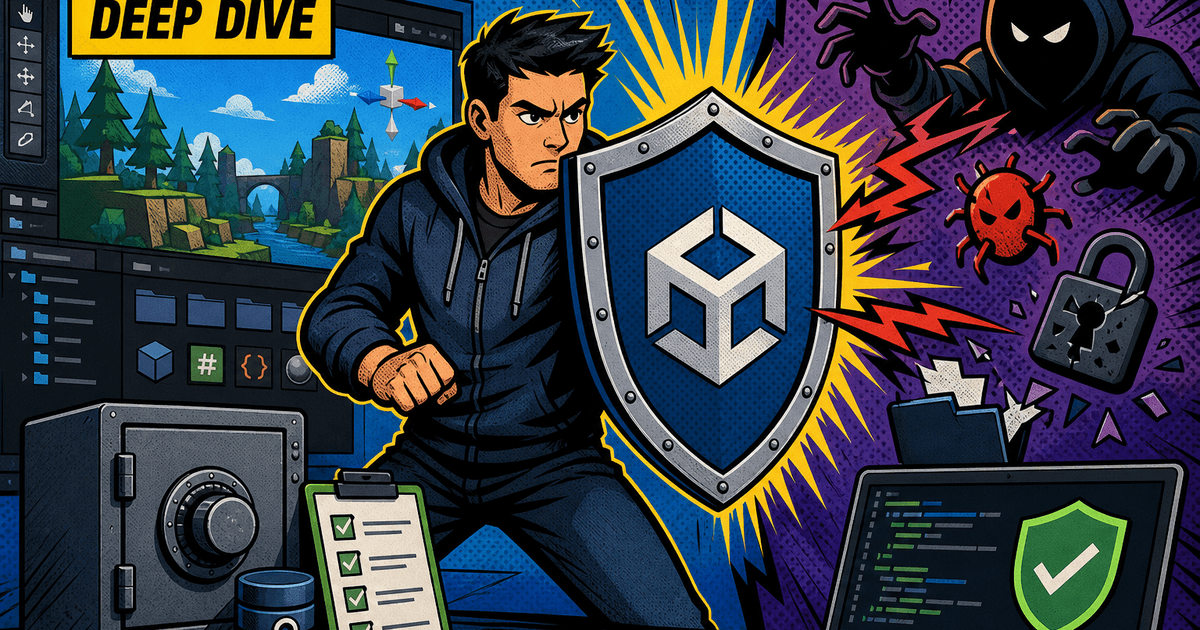
Why Unity dev tools security matters: The attack surface you're already exposing
Every package you import, every editor extension you install, and every cloud service you connect to your project expands your attack surface. Unity dev tools security and privacy considerations aren't a compliance checkbox-they're operational risk you carry from the moment you open the Package Manager. A compromised third-party SDK doesn't just cost you a bug fix; it can leak source code, exfiltrate build artifacts, or plant persistent access in your CI pipeline.
Most teams treat the editor as a trusted sandbox. It isn't. Editor scripts run with full filesystem access, network calls go unmonitored by default, and asset store packages execute arbitrary C# the moment they're imported. If you're not auditing what runs during import and build, you're trusting every publisher in your dependency tree with the same privileges as your own code.
The cost of ignoring this compounds silently. A leaked API key in a public repo gets scraped by bots within minutes. A malicious package with a delayed payload can sit dormant through several sprints before triggering during a production build. Treat your toolchain like production infrastructure, because functionally, it is.
Package dependencies and supply chain risk: Auditing your asset store and third-party tools
Unity's package ecosystem is a supply chain, and supply chains get attacked. Asset Store publishers aren't vetted for code quality or security practices-only for basic content policy compliance. A five-star rating tells you nothing about whether a package phones home or bundles obfuscated DLLs.
Before importing anything, run this checklist:
- Check the source, not just the .unitypackage. If a tool doesn't provide readable source or ships pre-compiled DLLs with no explanation, treat it as opaque and untrusted until proven otherwise.
- Review update frequency and changelog quality. Abandoned packages accumulate unpatched vulnerabilities; vague changelogs ("bug fixes and improvements") hide what actually changed.
- Grep for network calls. Search imported code for
UnityWebRequest,HttpClient, or raw socket usage. A local input system shouldn't be making outbound HTTP calls-if it is, find out why. - Pin versions in your manifest.json. Floating version ranges (
"^2.1.0") let a compromised update silently propagate into your project on the next resolve. - Isolate evaluation. Test new packages in a throwaway project before merging into your main branch, especially anything touching build scripts or editor tooling.
Git-based package dependencies deserve extra scrutiny. A package pulled from a GitHub URL with no tag pinning means the maintainer can push new code that gets pulled into your next build without your knowledge. Pin to a specific commit hash, not a branch name.
If you're still importing packages straight from the Asset Store into your production branch without a review pass, you're accumulating security debt that someone eventually pays for-usually during an incident, not during a code review.
Editor credentials and authentication: Stopping credential leaks before they start
Unity Editor stores a surprising amount of sensitive material in plaintext or lightly obfuscated form: Unity ID tokens, Cloud Build API keys, Version Control credentials, and third-party service keys for things like Firebase or PlayFab. Any of these leaking turns into an incident.
Common leak vectors you need to close:
- Hardcoded API keys in scripts. If a key is sitting in a
.csfile, it's in your git history forever, even after you delete it. Rotate it and use environment variables or a secrets manager instead. - EditorPrefs and ProjectSettings exposure. Some tools store auth tokens in
ProjectSettingsfiles that get committed by default. Audit your.gitignoreto exclude anything underUserSettings/and checkProjectSettings.assetfor embedded credentials. - Shared Unity accounts. Teams sharing a single Unity ID for Cloud Build or Version Control access lose all audit trail. Every team member needs an individual, scoped account.
- Unity Hub license leakage. Floating license files and organization seats get mismanaged when offboarding isn't tied to account deactivation. Remove access the day someone leaves the project, not at the next audit cycle.
Enforce two-factor authentication on every Unity ID with organization-level access. This is non-negotiable if your organization manages Cloud Build, Unity Gaming Services, or paid seat licenses-a single compromised account can pull private repositories, trigger builds, or drain service quotas.
Build pipeline security: Hardening your toolchain against injection and tampering
Your build pipeline is the highest-value target in your toolchain, because a compromise there doesn't just leak code-it ships malicious payloads to end users. Injection risks live in places most teams never inspect: pre-build scripts, post-processors, and CI runner configurations.
Harden these specific points:
- Lock down
IPreprocessBuildWithReportandIPostprocessBuildWithReportimplementations. These run with full system access during builds. Any package that hooks into these interfaces should be reviewed line by line, since this is the most common place for supply chain attacks to hide persistence. - Validate your CI runner isolation. If you're using self-hosted runners for Unity Cloud Build alternatives (Jenkins, GitHub Actions, GitLab CI), make sure build agents don't share filesystem or credential scope with other projects. A compromised build for one game shouldn't expose secrets for another.
- Checksum your Unity Editor installation. Tampered editor binaries are rare but real, especially in environments where installers get shared via internal file servers instead of pulled from Unity Hub directly.
- Sign your build artifacts. Whether you're targeting mobile, desktop, or console, code signing isn't just a store requirement-it's your last line of defense against a tampered build reaching users undetected.
- Restrict who can modify build scripts. Treat
Editor/folder changes touching build logic with the same PR scrutiny as production server code, because that's effectively what it is.
A ten-minute review of a new build dependency today prevents a multi-day incident response scramble after a tampered build ships to production.
Data privacy in dev tools: What your profiler, analytics, and cloud services actually capture
Development tools capture more data than most teams realize, and a lot of it leaves your machine without an explicit decision on your part. The Unity Profiler, Unity Analytics, Cloud Diagnostics, and third-party crash reporters all collect telemetry that can include device identifiers, IP addresses, and in some misconfigured cases, in-game user data during testing.
Know what's actually being collected:
- Unity Analytics and Unity Gaming Services capture device model, OS version, session length, and custom events you define. Review your event schema for anything that inadvertently logs personally identifiable information-usernames, emails, or precise location data.
- Crash reporters (Firebase Crashlytics, Sentry, Bugsnag) often capture stack traces that include local file paths, which can leak your build machine's username or directory structure. Scrub these before treating crash logs as safe to share externally.
- Profiler network captures can log request/response payloads during testing sessions, including auth tokens sent to backend services. Never share raw profiler captures without redacting headers.
- Third-party SDKs bundled with ad networks or analytics frequently have their own data collection running independent of your explicit calls. Check each SDK's privacy manifest, especially for iOS builds where Apple now requires disclosure of third-party data collection via privacy manifests.
If your project handles any regulated data-health information, financial data, or data from users under 13-map exactly which dev tools transmit data externally before you ship, not after a regulator asks. GDPR and COPPA compliance failures often originate in dev tooling defaults nobody reviewed, not in the shipped product's explicit features.
Access control and team permissions: Enforcing security across your development environment
Flat access models-where every team member has full repo, build, and service access-work fine until someone's account gets phished or a contractor's access isn't revoked on schedule. Access control isn't bureaucracy; it's damage containment.
Structure permissions around these principles:
- Scope Version Control access by role. Artists don't need write access to build scripts. Engineers on gameplay systems don't need access to backend service credentials. Use branch protection rules and CODEOWNERS files to enforce this at the repo level, not just as a policy document nobody reads.
- Separate service credentials by environment. Development, staging, and production API keys should be different keys entirely, with production keys accessible to a minimal set of people. A leaked dev key should never be able to touch production data.
- Audit Unity Organization roles quarterly. Unity's dashboard lets you assign Owner, Manager, and User roles at the org level-most teams set this once and never revisit it as people change roles or leave.
- Use signed commits for anyone with merge access to build-critical paths. This closes the gap where a compromised local machine could push malicious commits under someone else's identity without detection.
- Time-box contractor and external access. Set expiration dates on any access grant to external collaborators rather than relying on someone remembering to revoke it manually.
The goal isn't to make development slower-it's to make sure a single compromised account or careless mistake has a contained blast radius instead of full-project exposure.
Incident response and audit logging: Building visibility into what your tools are doing
You cannot respond to an incident you can't see. Most Unity projects have zero audit logging on editor activity, package changes, or build triggers, which means when something does go wrong, you're reconstructing the timeline from memory and git blame instead of logs.
Build visibility into your toolchain now:
- Enable Unity Cloud Build and Unity Gaming Services activity logs where available, and export them to a retained log store rather than relying on the default short retention window.
- Log package manifest changes in CI. A simple pre-build step that diffs
manifest.jsonagainst the previous build and flags new or changed dependencies catches supply chain injection before it reaches production. - Track build trigger sources. Know whether a build was triggered by a scheduled job, a manual push, or an API call-unexplained build triggers are often the first visible sign of a compromised pipeline.
- Maintain an incident response runbook specific to your toolchain. Know in advance who rotates which credentials, who has authority to pull a compromised package, and how quickly you can roll back a tampered build to a known-good artifact.
- Run a tabletop exercise annually. Walk through a hypothetical compromised package or leaked build credential with your team before it happens for real. The teams that respond well to incidents are the ones that rehearsed the response, not the ones improvising for the first time under pressure.
Security in your dev tools isn't a one-time hardening pass-it's an ongoing discipline that has to scale with your team and your dependency list. The projects that get burned are almost always the ones that treated their toolchain as inherently safe just because it's "just development," not production. It isn't. Your editor, your pipeline, and your dependencies are production infrastructure the moment they touch anything that ships.
Related Reading
Article complete
XP lands automatically when you reach the end.
Rate this article
Comments
Comments are held for moderation before appearing publicly.